March 14, 2026
When Asking for Help Isn’t Enough
In a recent post, I suggested a simple rule for our lab:
If you are stuck for more than two weeks, that is a signal to involve me. Being stuck is normal; staying stuck alone is not.
But reflecting on this further made me realize that there is a second, equally important aspect of this idea.
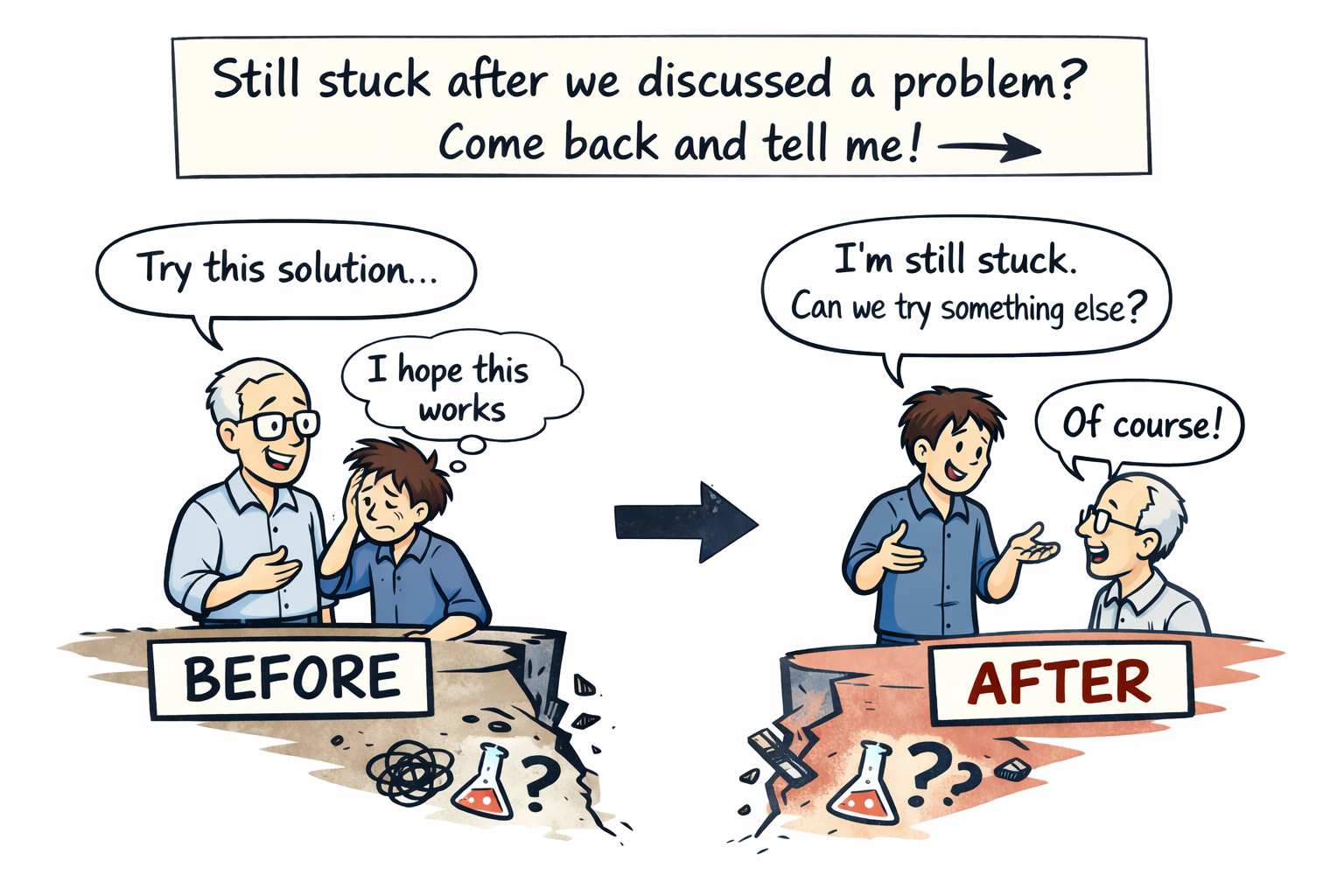
What if someone in the lab did ask for help, but the problem still persists?
This situation can happen more easily than we might think. Sometimes a student or postdoc raises a problem, we discuss it briefly, and I offer a suggestion or two. From my perspective, the issue has been addressed, and the project should move forward. But from the perspective of the person working on the project, the difficulty may still be very real.
In other words, I might believe I helped, while the person doing the experiment still feels stuck.
There are also practical reasons why this can happen. Mentors are often juggling many responsibilities - writing grants, reviewing papers, attending meetings, and advising multiple projects at once, or taking some time out for themselves - living in the Wild West has its benefits :-) and we are all human. Even with the best intentions, a response might be slower than it should be, or a suggestion might miss the core difficulty of the problem.
For this reason, I want to make another principle explicit:
If you asked for help and you are still stuck, come back and tell me.
Mentoring is not a one-step process. It is iterative. Sometimes the first suggestion works immediately, but often it does not. That is normal. In those cases, the most productive thing we can do is look at the problem again together.
No one should feel hesitant to say something like:
“I tried what we discussed, but I am still stuck.”
or
“I may not have explained the problem well last time. Could we look at it again?”
Those are not signs of failure. They are signs that the scientific process is working the way it should.
Good mentoring depends on honest feedback in both directions. Just as students and postdocs benefit from advice and guidance, mentors also depend on clear signals when something is not working. Without that feedback, it is easy to assume that a project is progressing when it is actually stalled.
Science is full of iterations - experiments are repeated, hypotheses are revised, and methods are refined. Mentoring works in much the same way. Conversations about difficult problems often need more than one round.
So, alongside the earlier rule about not staying stuck alone, I would add a second one:
If the first attempt at solving a problem does not help, come back and ask again.
Those follow-up conversations are often the ones where real progress begins.
Parts of the phrasing in this post were refined with the help of AI to make my ideas clearer and more concise. The ideas themselves are my own. The accompanying cartoons were also generated with AI.