When to Ask for Help
March 12, 2026
One interesting aspect of mentoring students and postdocs in research is that the phases that feel most enjoyable are often those when everything is working well. Experiments work, data accumulate, papers begin to take shape, and everyone feels the excitement of discovery. Yet the moments when mentoring truly matters are usually the opposite ones: when a project stalls and someone needs support.
Research is not a straight path. Experiments fail, methods do not behave as expected, or a project simply refuses to move forward despite weeks of careful work. These phases can be frustrating and sometimes isolating, especially for students - and sometimes postdocs as well - who feel they should be able to solve every problem on their own.
Over the past months, I have realized that, despite regular meetings and open conversations, I sometimes do not notice early enough when someone in the lab is struggling with a project. Students are often very good at carrying problems quietly, hoping they will solve them on their own. Postdocs are usually more experienced, but even they can sometimes go through phases where a project quietly stalls. By the time the difficulty becomes visible, the frustration may already have lasted for weeks or even months.
That realization made me think about how to make it easier to bring problems forward earlier. I recently came to a simple conclusion that I want to communicate clearly going forward:
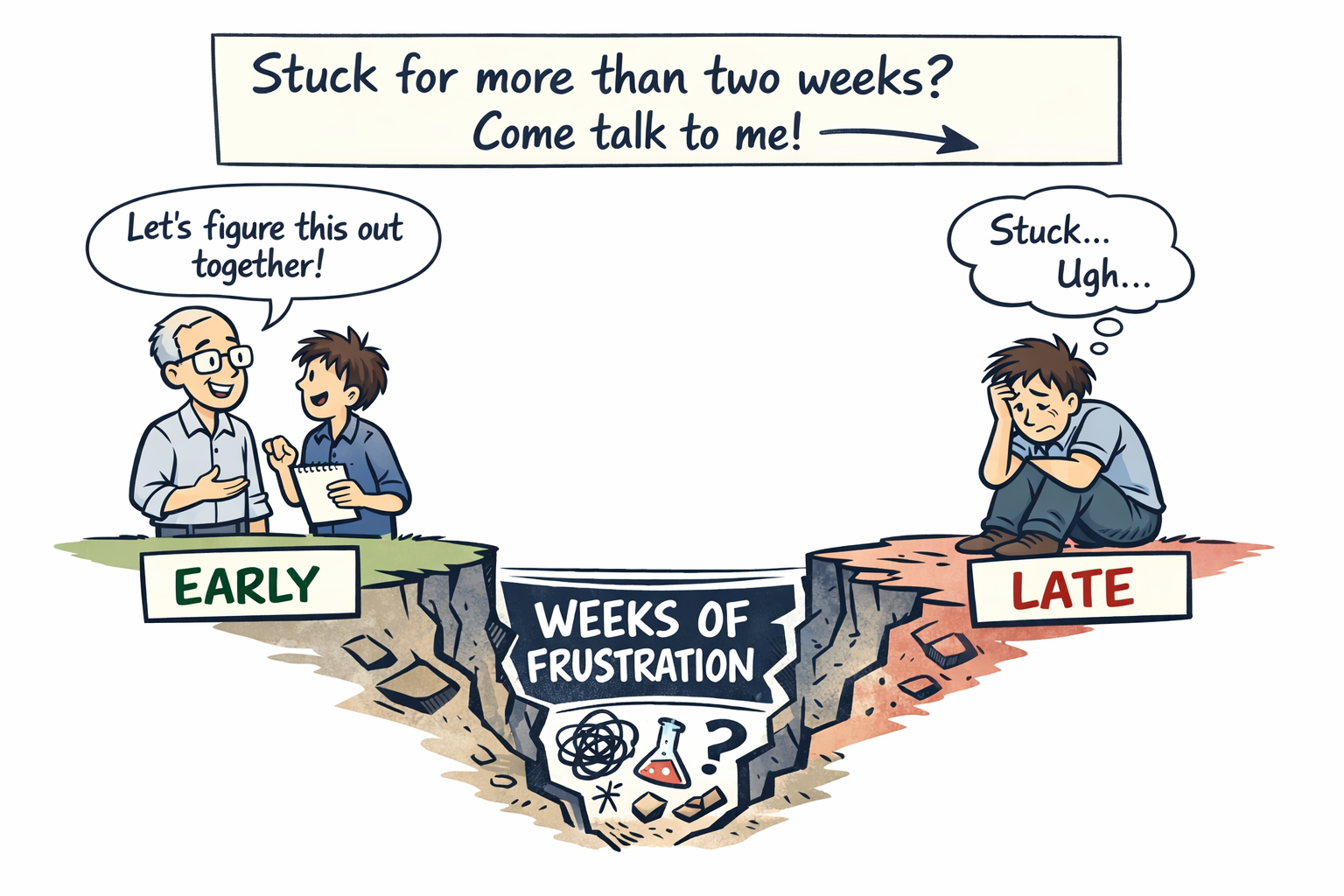
If you are stuck for more than two weeks, that should be a signal to involve me. Being stuck is normal; staying stuck alone is not.
This is not meant to limit independence. Independence in science does not mean solving every problem in isolation. It means knowing when to seek input, when to discuss an obstacle, and when to bring fresh eyes to a difficult problem.
In fact, the moments when someone in the lab is struggling are often the most rewarding moments for mentoring. Those are the times when a short conversation can open a new perspective, when a technical issue can be identified quickly, or when a different strategy suddenly makes progress possible again.
There is also a practical reason for raising problems early. Months of quiet frustration rarely improve a project. Discussing a difficulty early almost always saves time and energy and helps shorten those painful phases where a project appears stuck.
Learning how to do science includes learning how to navigate uncertainty, failed experiments, and unexpected obstacles. None of us learns that alone. Good mentoring works best when problems are shared early, and we can think them through together.
So this is a small adjustment I plan to make more explicit in our lab: if you find yourself stuck, frustrated, or unsure how to move forward for more than a couple of weeks, bring it up. Those moments are not interruptions of the scientific process — they are exactly where mentoring matters most.
Parts of the phrasing in this post were refined with the help of AI to make my ideas clearer and more concise. The ideas themselves are my own. The accompanying cartoons were also generated with AI.